

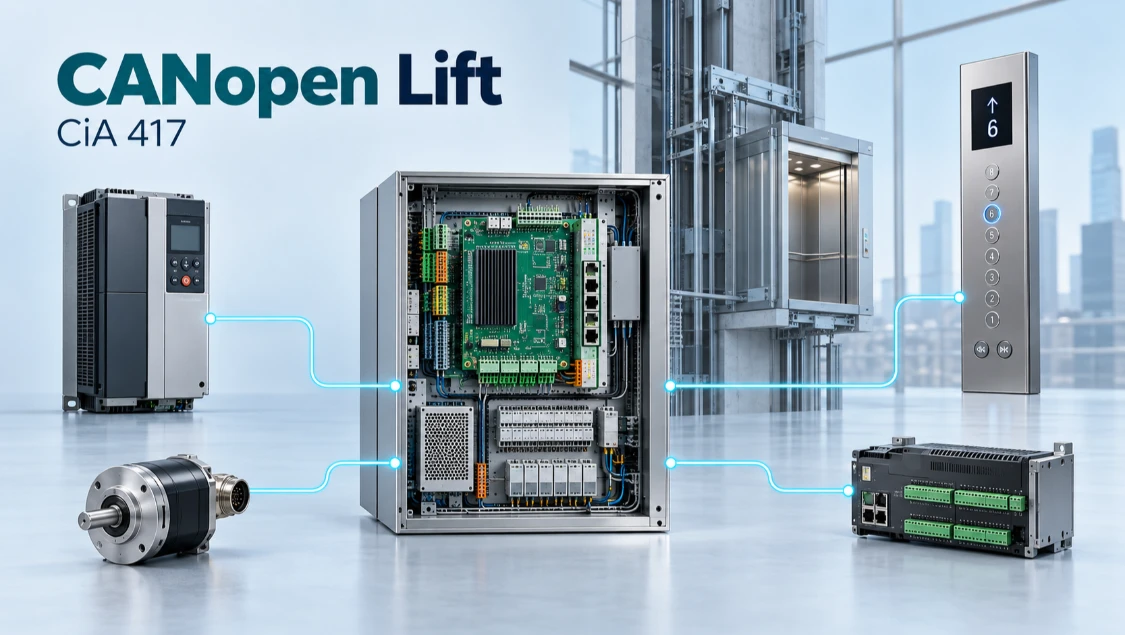
 An elevator brings together a control board, motor drive, door controller, landing and car operating panels, position sensors and load-weighing devices. For these components to work together, information must be exchanged correctly.
CANopen is a communication system that establishes common rules for communication between devices. The CANopen Lift — CiA 417 application profile adapts this common language to the functions of elevator components.
What is the difference between CAN, CANopen and CANopen Lift?
These terms are related, but describe different layers.CAN provides the foundation for data communication between devices. CANopen defines how devices share data, settings and operating states on that foundation. CANopen Lift is the application profile for using CANopen in elevator systems.
A “CANbus” label alone therefore does not establish support for CANopen or CiA 417. A CAN-based system may instead use a manufacturer-specific communication protocol.
Which components does CiA 417 cover?
Developed by CAN in Automation, CiA 417 defines standardized communication interfaces for elevator functions, including call control, car motion, door control, input and output panels, car position, load measurement and light barriers.A key feature is the virtual device approach. A device in this context does not necessarily mean a separate physical board. A car operating panel, for example, can combine an input unit that transmits button information and an output unit that controls indicators in the same hardware.
How does communication work?
CANopen devices store parameters and data in an organized structure called the object dictionary. It provides access to device settings and operating information through defined addresses.Some of the main communication mechanisms are:
- PDO: Transfers high-priority control and status information.
- SDO: Reads and writes parameters in a device’s object dictionary.
- Heartbeat: Helps monitor whether a device is present on the network and remains in the expected communication state.
What benefits can it bring to elevator projects?
A standardized communication profile can simplify component integration. When manufacturers describe the same functions through common data definitions, the need to develop a completely different communication solution for every connection is reduced.This approach also supports evaluating different suppliers of suitable products and accessing device data more consistently during maintenance. The actual benefits depend on the profile functions implemented by the products and correct system configuration.
Do different brands work together directly?
Supporting the same communication standard does not mean operating without configuration under every circumstance.CANopen also allows manufacturer-specific functions. Devices conforming to the same profile can provide interoperability and some degree of interchangeability, but their supported functions, profile versions and configuration must be compared.
When selecting a product, look beyond “CANopen supported” and ask:
- Does it support the elevator-specific CiA 417 profile?
- Does its implementation include the functions required by the project?
- Are compatibility with the control system and the necessary settings documented?
Are CANopen and CANopen Safety the same?
CANopen communication must be distinguished from safety-related communication. CANopen Safety is a separate protocol for safety-related data communication, standardized in EN 50325-5.Support for CANopen or CANopen Lift does not automatically imply support for CANopen Safety. Project safety functions must be assessed separately using the relevant device documentation and system design.
The right product-selection question: Which functions and which profile?
The value of CANopen Lift lies in providing a common, defined communication structure between elevator components. Taking advantage of it requires functional compatibility as well as a communication connection.Comparing profile support and implementation scope at the start of a new installation or modernization project can make commissioning and subsequent maintenance more predictable.